
|
In short: The May 2026 Saudi grid code requires an EMT study wherever a solar or battery connection falls below a short-circuit ratio of 3.0, and makes fast frequency response a duty for transmission-connected batteries. Australia met the same weak-grid problems first, and its public record shows the delays come from models, settings and late equipment changes. Gulf developers, lenders and utilities can settle most of these before the first bid is priced.
The Saudi grid code now draws a firm line for large solar and battery storage (BESS) at weak points in the network. The Saudi Arabian Grid Code, May 2026, prepared by National Grid SA and Marafiq and approved by SERA, sets a short-circuit ratio threshold, requires electromagnetic transient (EMT) studies below it and gives batteries a fast frequency response duty. Australia met the same problems earlier. Its public record shows where the time and money go. What the Saudi grid code requires for solar and BESS Weak-grid threshold and EMT studies The short-circuit ratio (SCR) at the connection point should be above 3.0. Below that, the developer must carry out a detailed EMT study with the transmission service provider (TSP) to show the plant connects and runs stably (clauses 2.10.10, 2.11.15.1 and 3.6.5). Models before the connection agreement For large projects the TSP may accept generic models at feasibility stage. Project-specific validated models, reflecting the actual plant and suppliers, are required before the connection agreement is finalised. Before energisation, studies using final manufacturer settings must confirm as-built performance, and TSP approval of those studies is a precondition for energisation (clause 2.4.7). Fast frequency response for batteries Transmission-connected BESS must be capable of fast frequency response (FFR). The code requires FFR to be fully available within one second and sustained for at least five seconds, and the completed response must not deviate by more than 1% over one minute. The MW and response time sit in each project's System Services Agreement (clauses 4.31.1 to 4.31.3). In our view, this shifts schedule risk from construction towards the study programme. A large solar or storage site at a weak node now carries an EMT workload, a dependency on the inverter supplier's models and a formal energisation gate. Australia has lived with that combination since at least 2019. 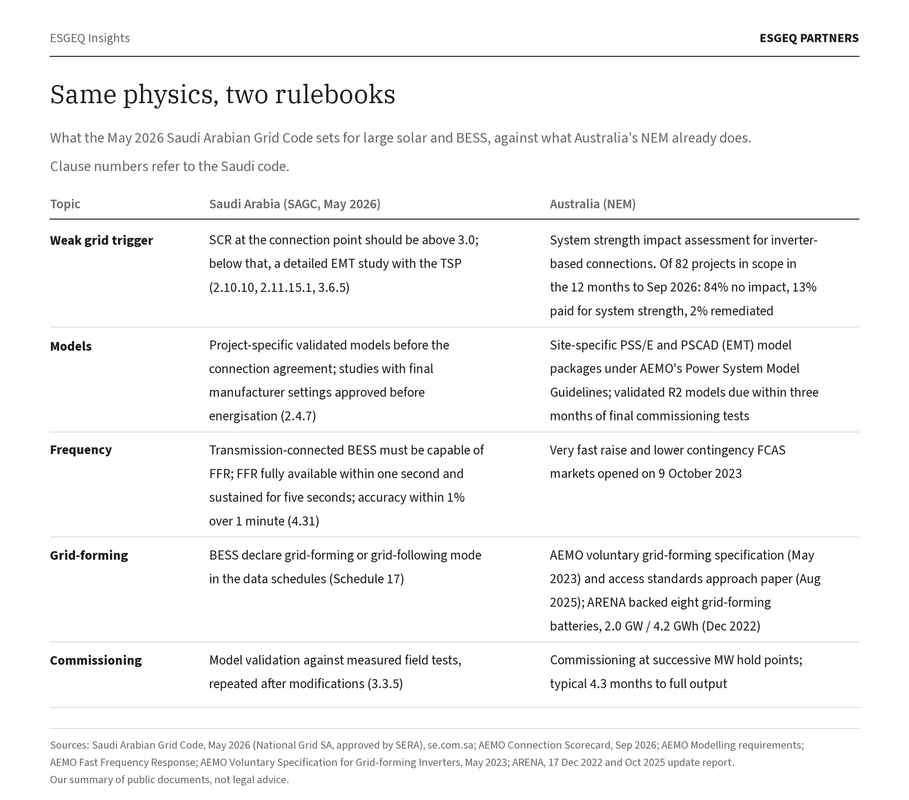
Australia's weak-grid lessons
West Murray: the problem showed up late In September 2019, AEMO constrained five operating solar farms in the West Murray zone of north-west Victoria and south-west New South Wales. AEMO's December 2019 report describes sustained voltage oscillations after a credible single line fault, made worse when several plants responded together. Cutting MW output alone did not fix it; reducing the number of inverters online did. AEMO also postponed final approvals for new generators due for commissioning or registration in the area, and declared a 312 MVA system strength gap at Red Cliffs. The constraints were provisionally lifted in April 2020, after retuned inverter settings passed testing. Three lessons carry straight to the Gulf. The problem was found by wide-area modelling, not by site tests. It came from plants interacting, so a study of one project in isolation can miss it. And the cost fell both on plants already running and on projects still in the queue. A system strength framework The AEMC's 2021 system strength rule made transmission companies responsible for planning system strength and, from March 2023, gave new inverter-based connections a choice: pay a system strength charge or remediate their own impact. AEMO's September 2026 connection scorecard shows how that plays out. Of 82 projects in scope for a system strength impact assessment in the last 12 months, 84% showed no impact, 13% chose to pay and 2% remediated. The models are the connection AEMO requires site-specific model packages for both PSS/E and PSCAD, its EMT tool, under its Power System Model Guidelines. Validated "R2" models are due within three months of the final commissioning tests. In November 2022 AEMO launched a Connections Simulation Tool, so applicants can test their own plant models against the same large-scale EMT model AEMO uses to assess connections. The Saudi grid code points the same way: generic models early, project-specific models before the connection agreement, and validation against measured field tests, repeated after modifications (clause 3.3.5). Our view is that the maturity of inverter and plant controller models should be a procurement criterion in the Gulf, assessed before the supply contract is signed rather than discovered after it. Performance standards are enforced Settings matter after connection too. Following South Australia's 2016 statewide blackout, the AER took four wind farm operators to the Federal Court for running repeat low voltage ride-through settings that AEMO and the network company had not approved in writing. Penalties ranged from A$550,000 to A$3.5 million, A$6.15 million in total (our sum). The Gulf lesson is not about penalties. In the largest case, the court record shows the settings were designed and applied by the turbine supplier, and the operators were not aware of them for years. Change control over inverter and plant controller firmware belongs in the supply and O&M contracts. Where connection time goes AEMO's September 2026 scorecard puts typical durations at 8.5 months for the application stage, 5.9 months for registration and 4.3 months from commissioning to full output, excluding time on hold. Commissioning runs through successive MW hold points, each confirming that measured behaviour matches the models. The developer-led implementation stage is the longest: its median rose from 14 to 18 months in FY26, and AEMO named design changes and equipment substitutions among the causes, because they need reassessment and rework. 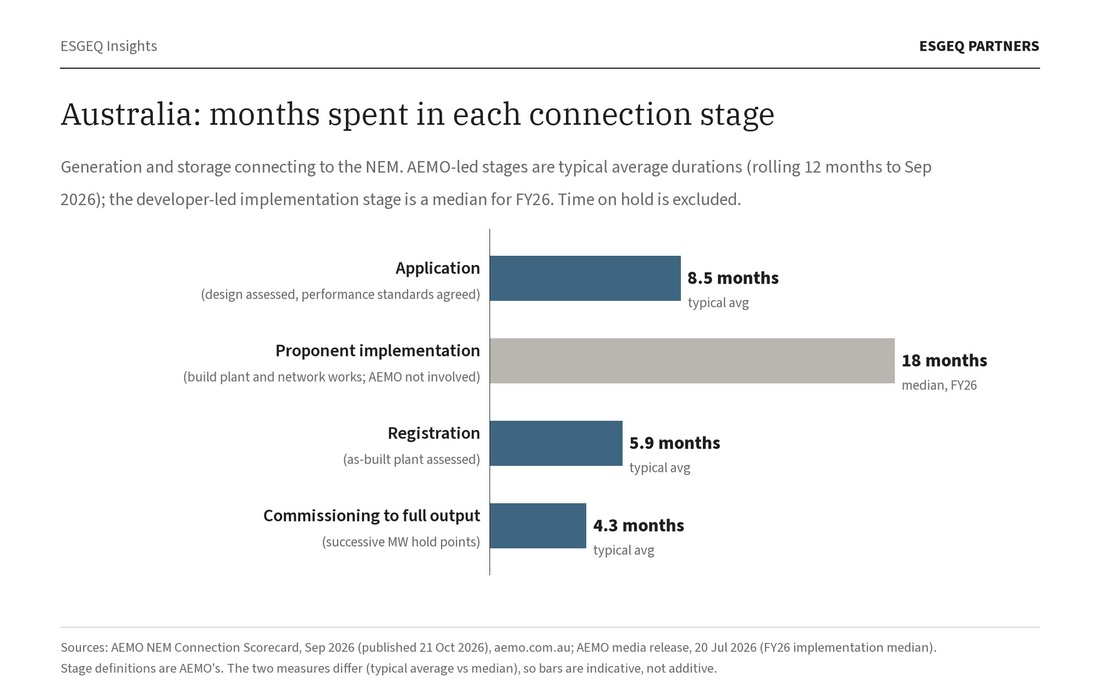
A late change of inverter or transformer is not only a commercial matter. It can reopen the studies.
Grid-forming batteries: decide at tender ARENA backed eight grid-forming batteries in December 2022, 2.0 GW / 4.2 GWh in total, and AEMO published a voluntary grid-forming specification in May 2023. ARENA's October 2025 update report records what followed. Grid-forming batteries were shown operating at very low SCR while consuming minimal system strength. Their treatment in system strength assessments was the main reason developers chose them. The same report shows the cost of deciding late. One project limited its inverters to 86% of maximum capacity to keep overcurrent headroom for inertial response. Converting an operating battery from grid-following to grid-forming needed new protection to manage arc flash risk, and at another site changed the harmonic profile enough that a filter might be needed. One developer concluded that running grid-forming from the outset is likely to be preferable. The Saudi grid code already asks every BESS to declare grid-forming or grid-following mode in its data schedules. In our view, Gulf procurers should decide which they want, and how it will be tested, before bids are priced. What we look for Developers
Lenders
Utilities
Sources
0 Comments
Leave a Reply. |
ArchivesCategories |
 RSS Feed